Cinema essay
Why is Sunrise So Colorful?
Have you ever stopped to think about why the sky can display such vivid colors at sunrise and sunset? Or wondered why the sky appears blue for most of the day? The explanation lies in the way visible light interacts with the atmosphere surrounding our planet.
Celine Lockhart
Desk writer
Spotlight note
The full essay continues below the still.
Reel
Midnight Cinema Desk
Have you ever stopped to think about why the sky can display such vivid colors at sunrise and sunset? Or wondered why the sky appears blue for most of the day? The explanation lies in the way visible light interacts with the atmosphere surrounding our planet.
Understanding Visible Light
To understand the colors we see in the sky, it helps to begin with visible light. What exactly is visible light, and why does it appear white?
Like radio waves and microwaves, visible light is a type of electromagnetic radiation. Electromagnetic radiation itself is a form of energy. The sun releases energy in several forms, including light waves that travel through space and reach Earth as sunlight.
These light waves contain a variety of frequencies. Together, these frequencies make up the portion of the electromagnetic spectrum that humans can see, known as visible light. In reality, visible light is not a single color. It consists of multiple frequencies, with each frequency being interpreted by our eyes as a different color. When all of these colors are combined, they are perceived as white light.
How Newton Revealed the Colors of White Light
In 1666, Isaac Newton was the first person to demonstrate that white light was actually made up of the colors found in a rainbow. He proved this by directing sunlight through a prism, which separated the light into its individual color components.
Each color within visible light travels at a different wavelength. Because of these differences, the colors bend by different amounts as they pass through a prism. This causes the white light to spread into the familiar range of rainbow colors.
The visible spectrum includes colors such as violet, indigo, blue, green, yellow, orange, and red. Violet and indigo have considerably shorter wavelengths than colors such as orange and red. These differences in wavelength are essential to understanding why the sky can appear in different colors at different times of the day.
Why Is the Daytime Sky Blue?
Under normal conditions, visible light moves in a straight path unless it is reflected, refracted, or scattered. This is where Earth's atmosphere becomes important.
The atmosphere contains countless tiny molecules, including oxygen and nitrogen. These molecules are extremely small when compared with the wavelengths of visible light. When sunlight enters the atmosphere, the shorter wavelengths are scattered more efficiently than the longer ones.
Blue and violet light have relatively short wavelengths, so they are scattered much more strongly throughout the atmosphere than red and orange light. This scattered blue light reaches our eyes from many directions, making the daytime sky appear blue.
If scattering were the only factor involved, however, we might expect the sky to look violet rather than blue. There is actually less violet light produced by the sun than blue light, and human vision is also less sensitive to violet than to blue.
Human eyes contain three primary types of color receptors, commonly associated with blue, green, and red. These receptors respond to different wavelengths of light to varying degrees, and the combined signals allow us to perceive the broad range of colors around us. The familiar deep blue of a clear daytime sky is therefore largely the result of blue sunlight being scattered throughout the atmosphere.
Why Can the Sky Look Hazy or Washed Out?
Sometimes the daytime sky does not appear as intensely blue as usual, and sunsets can also look less vibrant. This can happen when additional particles are suspended in the atmosphere.
Pollution, dust, and other relatively large particles can become concentrated close to the Earth's surface within the boundary layer. When this occurs, the colors in the sky may appear less pure and more muted. These larger particles do not scatter light in the same way as the tiny atmospheric molecules, so they do not separate the colors as effectively.
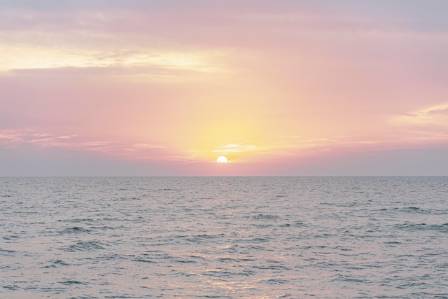
A hazy sunset, for example, may produce softer pastel shades such as peach, pale pink, and light blue rather than intense and highly saturated colors.
Why Clear Air Produces Better Sunrises and Sunsets
Since large particles in the atmosphere can reduce the clarity and intensity of colors, clean and clear air is often ideal for viewing particularly striking sunrises and sunsets.
This is one reason winter can be an especially good season for dramatic skies, particularly in the northeastern United States. During winter, the air is often cold, dry, and clear, creating conditions that can allow colors to appear more vivid.
There is another way to escape some of the hazier air near the surface: simply rise above the boundary layer. From an airplane, for instance, an ordinary-looking sunrise or sunset can sometimes become much more spectacular after the aircraft climbs above the layer of less-clear air. With fewer particles between the observer and the sun, the view becomes considerably clearer.
Why Are Sunrises and Sunsets So Colorful?
This brings us back to the central question: why do sunrises and sunsets often display such remarkable colors?
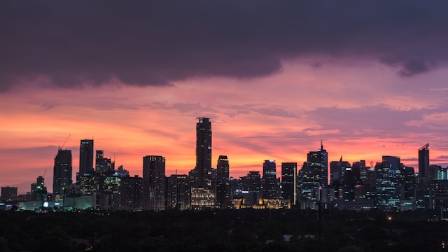
As blue light is scattered throughout the atmosphere, more of the longer wavelengths remain, including orange and red. At sunrise and sunset, the sun is positioned low in the sky. As a result, its light has to travel through a much greater thickness of atmosphere before reaching an observer.
The longer path gives the atmosphere more opportunity to scatter away the shorter blue wavelengths. By the time the sunlight reaches our eyes, the remaining light contains a greater proportion of the longer wavelengths, producing the familiar orange, red, and related colors associated with sunrise and sunset.
The amount of atmosphere that sunlight travels through increases as the sun moves closer to the horizon, making the filtering of blue light increasingly significant.
How Clouds Enhance the Colors
The scattering of sunlight explains much of the color we see around sunrise and sunset, but clouds can make these scenes even more dramatic.
Clouds are made up of water droplets, ice crystals, or a combination of the two. These clouds can reflect light from the setting sun, adding another layer of illumination and color to the sky.
The interaction between sunlight, the atmosphere, and clouds can create an extraordinary range of visual effects. Depending on atmospheric conditions and whether clouds are present, the sky at sunset can shift through brilliant reds and oranges, delicate pinks and peaches, soft blues, and many other shades.
Together, the scattering of light, the changing path of sunlight through the atmosphere, atmospheric particles, and cloud reflections explain why some sunrises and sunsets can become such spectacular displays.
More from the desk
· Mono
5 Remarkable Benefits of Coconut
Coconuts, the fruit of the Cocos nucifera palm, offer a rich source of nutrients and are widely appreciated for both their culinary versatility and potential health advantages. Popular in tropical and coastal regions, this fruit can be consumed raw or processed into a variety of products like oil, milk, flour, and dried shavings.

· Mono
The Most Adorable Duck Breeds You Have to See
Ducks are a riot of personality and color, and some breeds stand out for their irresistible charm from hatchling to adulthood. This piece highlights a handful of cute duck breeds, exploring what makes them special, whether as backyard companions or simply as captivating sights in the wild or in zoos.
· Mono
Red sky at night and other weather lore
For centuries, people have used weather sayings to predict changing conditions before modern forecasting technology existed. Long before satellites, computers, and advanced weather models, communities depended on careful observation of nature and generations of shared experience.

· Mono
Metamorphosis in Makeup: Celebrity Transformations Unveiled
Celebrities often serve as style icons, and their makeup transformations over the years provide a fascinating glimpse into the evolution of beauty trends. While some stars maintain a consistent signature look, others undergo drastic changes that redefine their public image. In this exploration, we delve into the captivating makeup metamorphoses of Taylor Swift, Mariah Carey, Kelly Osbourne, Christina Aguilera, Avril Lavigne, Kim Kardashian, Khloé Kardashian, Kylie Jenner, and Katy Perry.

· Mono
Five Fascinating Facts About Kangaroos
Kangaroos are among Australia’s most recognizable animals, but there is much more to these unique marsupials than their famous hopping ability. From their family structures to their survival skills, here are five interesting facts about kangaroos.

· Mono
Modern Chair Design
Modern chair design is redefining our perception of seating. As we spend more time at home and place greater value on comfort, aesthetics, and functionality, the demand for innovative chair designs has surged. From streamlined minimalism to ergonomic wonders, there’s something to suit every taste. In this article, we’ll explore the latest trends, materials, and technologies that are reshaping the world of chairs. Whether you’re an interior designer, a homeowner, or simply someone who appreciates stylish furniture, this comprehensive guide will offer valuable insights into the captivating realm of modern chair design.