Cinema essay
What Happens When Two Planets Collide?
Planetary impacts are among the most dramatic and influential events in the history of any solar system. These immense collisions can completely reshape worlds, alter their internal structure, and even create entirely new celestial bodies.
Adrian Pierce
Desk writer
Spotlight note
The full essay continues below the still.
Reel
Midnight Cinema Desk
Planetary impacts are among the most dramatic and influential events in the history of any solar system. These immense collisions can completely reshape worlds, alter their internal structure, and even create entirely new celestial bodies.
Although such events are uncommon today, they were frequent during the early stages of solar system formation, especially during a turbulent era known as the Late Heavy Bombardment. During these encounters, tremendous kinetic energy is released, producing effects that can either destroy planets, combine them, or generate new moons and debris systems. The final result depends on factors such as impact speed, collision angle, and the size of the objects involved.
Types of Planetary Collisions
The consequences of a planetary impact are largely determined by how fast the bodies are moving and the angle at which they meet. Scientists generally classify these events into three major categories.
A grazing collision, often referred to as a “hit-and-run” event, occurs when two planetary bodies strike each other at a shallow angle. In these encounters, the outer layers and atmospheres may be stripped away while the dense metallic cores remain mostly intact. Even though the planets survive, large amounts of debris can still be launched into space.
A catastrophic collision happens when planets crash together at extremely high velocities. The enormous energy released can completely break apart one or both worlds, scattering fragments throughout the surrounding region. Significant portions of both mantle and core material may be lost during such an event.
An accretionary collision, also known as a merger, takes place when two bodies collide more directly and at lower speeds. Instead of being destroyed, the materials combine to form a larger planet with a newly reorganized internal structure.
The Immediate Impact: Energy and Material Changes
The instant two planets collide, vast amounts of kinetic energy are converted into heat, pressure, and shockwaves. Research suggests that approximately 70–91 percent of the impact energy becomes internal energy, driving major physical and chemical transformations.
The collision generates pressures that can exceed one million times Earth’s atmospheric pressure. Powerful shockwaves travel through the interiors of both worlds, dramatically altering their structure.
Extreme heating causes large portions of the crust and mantle to melt. Rock, ice, and other materials can transform into superheated fluids or gas. Under the highest pressures, even iron from planetary cores may vaporize and become plasma. This material can rapidly expand and spread throughout the surrounding region.
When a planet has an atmosphere, a major impact can remove a substantial portion of it. The force of the collision may compress and eject atmospheric gases along with parts of the mantle below. Simulations indicate that the impact responsible for creating Earth’s Moon may have removed between 10 and 60 percent of Earth’s original atmosphere. Such atmospheric loss can strongly influence a planet’s future climate and habitability.
The Aftermath: Building New Celestial Structures
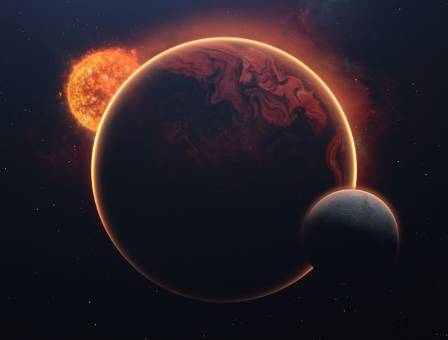
Once the initial explosion settles, gravity begins reshaping the scattered material. Vaporized rock, molten debris, and dust form a massive ring around the surviving planetary remnant. This structure, known as a debris disk, can remain in orbit while gradually cooling and evolving.
Over time, gravity pulls the material together through a process called re-accretion. This can lead to the formation of one or more moons. Recent computer models suggest that large satellites may form much faster than previously believed, potentially taking shape within only a few hours after the impact.
The surviving planetary bodies are also transformed. In merger events, the cores of the colliding planets combine to create a larger world with altered composition and rotation. In more violent impacts, a planet’s rocky mantle may be stripped away, leaving behind a dense core rich in iron and heavy elements.
Evidence of Ancient Planetary Collisions
One of the strongest examples of a planetary collision is the Giant Impact Hypothesis, which explains the origin of Earth’s Moon. According to this model, a Mars-sized object called Theia struck the young Earth about 4.5 billion years ago. Material ejected from the collision eventually gathered together to form the Moon. Evidence for this theory comes from the nearly identical isotopic compositions found in lunar rocks and Earth materials, suggesting a shared origin.
Several unusual features within our Solar System may also be the result of ancient impacts. Mercury possesses an exceptionally large iron core relative to its size, leading scientists to believe that a powerful collision stripped away much of its outer rocky layers. Uranus, which rotates on its side, is thought to have experienced a massive impact that dramatically altered its orientation.
Astronomers have discovered similar clues in distant planetary systems. The exoplanet Kepler-107c is significantly denser than a neighboring planet of similar size, suggesting that a violent collision removed much of its lighter outer material and exposed its dense core.
Observations of large clouds of warm dust surrounding certain stars also provide direct evidence of planetary crashes. Systems such as BD +20 307 appear to contain debris produced by the relatively recent collision of mature planets.
Conclusion
Planetary collisions are powerful events that have played a crucial role in shaping the Solar System and countless other planetary systems throughout the universe. Depending on the conditions of the impact, these encounters can merge planets, strip away their outer layers, create moons, or completely destroy worlds.
From the formation of Earth’s Moon to the unusual structures of Mercury and Uranus, evidence of ancient impacts can be found throughout our cosmic neighborhood. Modern observations of distant exoplanets and debris-filled star systems continue to reveal that planetary collisions remain an important process in the evolution of planets.
By studying these colossal events, scientists gain valuable insights into how worlds form, change, and sometimes disappear, helping us better understand the dynamic history of the universe.
More from the desk

· Mono
The Impact of Digital Technologies
Technology has the potential to make the world more equitable, peaceful, and just. Digital innovation can play a major role in advancing all 17 Sustainable Development Goals—from eliminating extreme poverty and lowering maternal and infant mortality to supporting sustainable agriculture, decent employment, and universal education. However, these same technologies can also pose risks, such as invading privacy, weakening security, and increasing inequality. They also raise important concerns about human rights and individual autonomy. As with past generations, governments, businesses, and individuals must decide how to responsibly develop and use these tools.

· Mono
Pickup Truck Buying Guide
Pickup trucks are no longer limited to being simple work machines. Today, they’ve evolved into everyday vehicles used for commuting, family transport, weekend travel, towing, and even luxury-style driving. Continuous improvements in design and engineering have turned modern trucks into highly capable, tech-filled vehicles that serve both commercial users and lifestyle-focused buyers.

· Mono
Big Ben Crowned the UK's Most Photographed Building!
Big Ben has been named the UK's most photographed building, with 3.2 million Instagram posts under #bigben, according to a study by Singulart. London dominated the top three spots, with Tower Bridge and Buckingham Palace taking second and third, and seven of the top ten buildings located in the capital. Architecture photographer Grégory Herpe also shared tips on how to avoid typical postcard shots by finding new angles and incorporating surrounding elements.

· Mono
Modern Chair Design
Modern chair design is redefining our perception of seating. As we spend more time at home and place greater value on comfort, aesthetics, and functionality, the demand for innovative chair designs has surged. From streamlined minimalism to ergonomic wonders, there’s something to suit every taste. In this article, we’ll explore the latest trends, materials, and technologies that are reshaping the world of chairs. Whether you’re an interior designer, a homeowner, or simply someone who appreciates stylish furniture, this comprehensive guide will offer valuable insights into the captivating realm of modern chair design.

· Mono
Easy-to-Care-For Saltwater Fish for Beginners
Starting a saltwater aquarium can feel overwhelming for a new marine hobbyist. Choosing the right fish requires careful consideration of several factors, including personality, feeding preferences, aquarium size, and water temperature needs.

· Mono
How Regular Exposure to Natural Sunlight Significantly Improves Human Health
While many people are aware of the potential risks associated with excessive sun exposure, receiving a balanced daily dose of natural light is highly beneficial for overall well-being. Regular contact with sun rays triggers essential biological processes that elevate psychological mood, stabilize nocturnal sleep cycles, and generate necessary nutrients. Even a brief window of time spent outdoors can produce measurable improvements in daily vitality, though the exact duration required varies based on individual skin characteristics and geographical location.