
Cinema essay
Why Do Galaxies Have Spiral Arms?
Picture yourself gazing into a clear night sky. As your imagination travels beyond the stars of the Milky Way, you enter the immense darkness of space. Scattered throughout this cosmic ocean are galaxies—enormous systems of stars, gas, dust, and dark matter. Many display stunning spiral patterns, with sweeping arms stretching outward in graceful curves like giant celestial whirlpools.
Hunter Price
Desk writer
Spotlight note
The full essay continues below the still.
Reel
Midnight Cinema Desk
Picture yourself gazing into a clear night sky. As your imagination travels beyond the stars of the Milky Way, you enter the immense darkness of space. Scattered throughout this cosmic ocean are galaxies—enormous systems of stars, gas, dust, and dark matter. Many display stunning spiral patterns, with sweeping arms stretching outward in graceful curves like giant celestial whirlpools.
These magnificent structures raise an intriguing question: why do spiral galaxies possess these swirling arms? Are they simply decorative arrangements of stars, or do they reveal important clues about the nature and evolution of galaxies?
To answer this, we need to explore the physics, history, and ongoing processes that shape these extraordinary cosmic systems.
Galaxies: Giant Communities of Stars
Galaxies are among the largest organized structures in the universe. They consist of billions or even trillions of stars, along with gas clouds, dust, stellar remnants, and vast amounts of invisible dark matter, all held together by gravity.
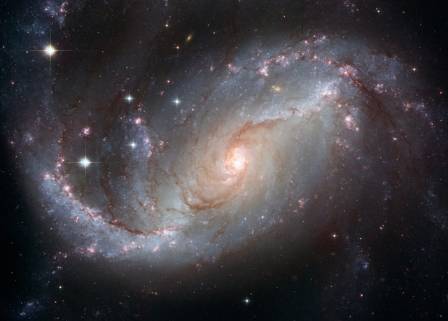
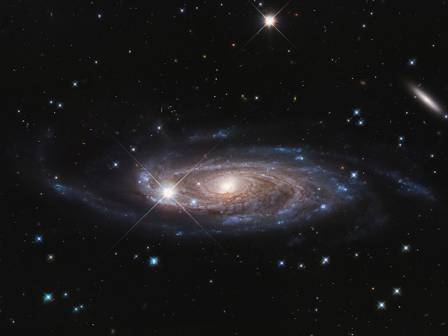
Astronomers classify galaxies into several categories, including spiral, elliptical, and irregular forms. Spiral galaxies are especially striking because of their flattened disks, central bulges, and prominent spiral arms extending outward from the center.
These arms are not merely decorative features—they are active regions that influence the development of the galaxy itself.
Understanding Spiral Arms
At first glance, it might seem that spiral arms are made up of the same stars constantly orbiting the galactic center together. In reality, the situation is far more interesting.
Spiral Arms Are Patterns, Not Permanent Structures
A common misunderstanding is that spiral arms behave like the rigid blades of a windmill. However, astronomers have discovered that they function more like traffic congestion on a busy roadway.
Imagine vehicles moving along a highway. Even though individual cars enter and leave a traffic jam, the congestion itself can remain in roughly the same location. Spiral arms behave similarly. Stars, gas, and dust continuously move through them, while the arms persist as regions where matter becomes temporarily concentrated.
These regions are known as density waves, and they are essential for explaining the long-lasting nature of spiral structures.
Historical Discoveries About Spiral Galaxies
The study of spiral galaxies evolved gradually over centuries.
Early astronomers could observe only a few fuzzy patches in the sky, often referred to as nebulae. With increasingly powerful telescopes, scientists began to recognize that many of these objects were actually entire galaxies.
In the twentieth century, astronomer Edwin Hubble established a classification system for galaxies and helped reveal the true scale of the universe.
The Winding Problem
Scientists soon noticed a major issue. Stars closer to a galaxy's center orbit faster than stars farther away. If spiral arms consisted of fixed groups of stars, they should gradually wind tighter and tighter over billions of years until the pattern disappeared.
This challenge became known as the winding problem.
Yet observations showed that spiral arms remained clearly visible. Therefore, another explanation was needed.
Density Wave Theory
In the 1960s, astronomers C. C. Lin and Frank Shu proposed the density wave theory, which remains one of the leading explanations today.
Galactic Traffic Patterns
According to this theory, spiral arms are not fixed collections of stars. Instead, they are wave-like regions of increased density that move through the galactic disk.
Individual stars travel through these regions, much like cars passing through areas of heavier traffic. The stars continue their own orbits, while the density pattern remains.
This concept explains why spiral arms can survive for billions of years without winding themselves into impossibly tight spirals.
Birthplaces of New Stars
As gas clouds enter a spiral arm, they become compressed by the increased density. This compression often triggers gravitational collapse, leading to the formation of new stars.
Because of this process, spiral arms contain many young, massive, blue stars that shine intensely. Their brightness makes the arms stand out clearly in astronomical images.
Older stars are distributed throughout the galaxy, but the spiral arms are especially rich in active star-forming regions.
How Spiral Arms Begin
While density waves explain the persistence of spiral arms, astronomers have also investigated how such structures originate.
Gravitational Disturbances
Large rotating galactic disks can become unstable. These instabilities may cause matter to gather into spiral-shaped patterns that later evolve into density waves.
Interactions With Nearby Galaxies
Close encounters between galaxies can disturb their structures. When a smaller galaxy passes near a larger one, gravitational forces can generate or strengthen spiral patterns.
This process resembles stirring cream into coffee and watching swirling patterns emerge.
Central Bars
Many spiral galaxies contain elongated bar-shaped structures near their centers. These bars can direct gas and stars into specific orbital paths, helping maintain spiral arms.
The Milky Way itself is believed to be a barred spiral galaxy.
Types of Spiral Galaxies
Spiral galaxies come in several forms.
Grand Design Spirals
These galaxies possess well-defined and symmetrical arms. They are among the best examples of long-lasting density waves.
A famous example is the Whirlpool Galaxy.
Flocculent Spirals
These systems display fragmented and patchy arms rather than clear, continuous structures.
Their appearance is often linked to localized star formation activity.
Multi-Armed Spirals
Some galaxies feature numerous spiral arms created by complex gravitational interactions and internal motions.
Barred Spirals
These galaxies contain a central stellar bar from which the spiral arms emerge.
Barred spirals are common throughout the universe and may represent an important stage in galactic evolution.
Spiral Arms and Stellar Creation
One of the most significant roles of spiral arms is their involvement in producing new stars.
Gas clouds entering dense spiral regions are compressed, leading to star formation. Massive stars born in these regions live relatively short lives before exploding as supernovae.
These explosions release heavier elements into surrounding space, enriching future generations of stars and planets.
As a result, spiral arms function as enormous stellar factories that continually recycle matter throughout the galaxy.
The Importance of Dark Matter
Dark matter plays a crucial role in maintaining galactic structure.
Although it cannot be observed directly, its gravitational influence prevents galaxies from flying apart due to their rapid rotation.
Dark matter helps stabilize galactic disks and may influence the formation and durability of spiral arms.
Without dark matter, many spiral galaxies would likely look very different from what we observe today.
Viewing Spiral Arms From Within
Humanity resides inside the Milky Way, specifically within a smaller structure known as the Orion Arm.
Because we are located inside the galactic disk, we cannot easily view the Milky Way from above. Instead, it appears as a luminous band stretching across the night sky.
Through radio observations, infrared imaging, and precise stellar measurements, astronomers have gradually mapped our galaxy's spiral structure.
Current models indicate that the Milky Way contains four major spiral arms along with several smaller branches.
Do Spiral Arms Last Forever?
Although spiral arms can survive for extremely long periods, they are not eternal.
Galaxies constantly evolve, and their structures change over time.
Gradual Transformation
Spiral patterns may weaken if the mechanisms supporting them diminish. Over billions of years, galaxies can lose their distinct arms and take on different shapes.
The Influence of Galactic Bars
Bars can funnel gas toward the galactic center, triggering intense periods of star formation. As available gas is depleted, spiral arms may become less prominent and eventually fade.
This gradual process is known as secular evolution.
The Future of the Milky Way
The future of our galaxy includes a dramatic encounter with the nearby Andromeda Galaxy.
A Future Merger
Astronomers predict that the Milky Way and Andromeda will collide in roughly four billion years.
Over time, gravitational interactions will distort both galaxies, disrupting their spiral arms.
Eventually, they are expected to merge into a much larger elliptical galaxy, sometimes nicknamed "Milkomeda."
Although the collision sounds dramatic, direct stellar collisions are unlikely because stars are separated by enormous distances.
From Spiral to Elliptical
This transformation reflects a common evolutionary pathway. Many spiral galaxies eventually merge and become elliptical systems with little or no ongoing star formation.
Modern Research Techniques
Astronomers use advanced technology to study spiral structures in greater detail.
Computer Simulations
Powerful supercomputers model galaxy formation and evolution by incorporating gravity, gas dynamics, dark matter, and star formation.
Projects such as Illustris and EAGLE have produced realistic simulations that help researchers test theories about spiral arms.
Gaia Mission
The European Space Agency launched the Gaia mission to map more than a billion stars in the Milky Way.
Its highly accurate measurements provide valuable information about stellar motions and the structure of our galaxy's spiral arms.
Spiral Arms and Cosmic Recycling
Spiral arms contribute to a continuous cycle of creation and destruction.
Gas clouds form stars, stars generate heavier elements, and supernova explosions distribute those materials throughout space.
Future stars and planetary systems then emerge from this enriched material.
This process ultimately produced the ingredients necessary for planets like Earth and for life itself.
The Birthplace of Our Solar System
Scientists believe that the Solar System formed approximately 4.6 billion years ago within one of the Milky Way's spiral arms.
The elements found on Earth were forged in earlier generations of stars that lived and died within similar stellar nurseries.
Spiral Shapes Beyond Astronomy
The spiral pattern appears throughout nature and human culture.
Spirals can be found in seashells, hurricanes, whirlpools, flowers, and even ancient artwork.
Many civilizations viewed spirals as symbols of growth, continuity, transformation, and infinity.
Because of their beauty and symbolism, spiral galaxies have inspired artists, writers, and philosophers for generations.
What Spiral Arms Teach Us
Spiral arms offer several important lessons about the universe.
They demonstrate that galaxies are dynamic systems rather than static collections of stars.
They reveal the influence of gravity, motion, and density waves on large-scale cosmic structures.
They serve as the primary locations for star formation and the creation of planetary systems.
They help astronomers understand the history and structure of the Milky Way.
Most importantly, they inspire curiosity and remind us of humanity's connection to the wider cosmos.
Conclusion
The existence of spiral arms is the result of complex interactions involving gravity, density waves, gas clouds, star formation, and dark matter. These remarkable structures are not permanent groups of stars but long-lasting patterns that guide the evolution of galaxies.
Within these vast cosmic spirals, stars are born, planets emerge, and the materials necessary for life are created. The Milky Way itself is part of this ongoing process, and our Solar System owes its existence to generations of stars that formed within spiral arms long ago.
Every image of a spiral galaxy reveals more than just beauty—it tells a story of motion, creation, and transformation on a scale that stretches across billions of years.
A Final Reflection
If intelligent life exists elsewhere in the universe, perhaps beings in another spiral arm are asking the same questions we ask today. They may be mapping their own galaxy, studying its structure, and wondering about the origins of the elegant spiral patterns that surround them.
Until those mysteries are answered, spiral arms will remain among the most breathtaking and fascinating features in the cosmos.
More from the desk
· Mono
Khiva, Uzbekistan: the Mysterious City at dawn
Walking through the narrow stone-paved lanes of Khiva’s historic walled city at sunrise was one of the most unforgettable moments of our journey through Uzbekistan. The soft golden glow, scattered white clouds, quiet pathways, and the gentle sound of birds created an atmosphere that felt almost unreal. During these peaceful early hours, the ancient city appeared like a mysterious vision rising from the surrounding desert.

· Mono
Pallas's cat: One of the world's oldest felines
Pallas's cat is a small wild feline found across Central Asia. Its short legs and extremely thick coat give it a much larger and heavier appearance than its actual size suggests. However, the unusual yelping sounds it makes when frightened or stressed can quickly reveal just how small this cat really is.

· Mono
Labor in Focus: Paintings that Honor Work
Observing Labor Day through an artistic lens offers more than a holiday break—it invites reflection on how painters have historically represented the skill, effort, and everyday reality of work. The following works—from household chores and factory floors to bustling markets, harvest fields, and civic engagement—present labor as essential to life while also providing invaluable lessons in composition, color, and technique for contemporary artists.

· Mono
Adorable Robots That Charm More Than They Think
When people imagine robots, they often picture one of two extremes: lovable little companions or intimidating machines straight out of a science-fiction nightmare.

· Mono
The Dog Family: Red and Corsac Foxes
Broadly speaking, many members of the dog family can be described as foxes. However, the word “fox” does not have a precise scientific definition. It is used for animals belonging to two separate evolutionary branches that are not actually close relatives. To make matters even more complicated, some species within those branches do not really fit what we would normally imagine when we hear the word “fox.”

· Mono
Minimalist Travel Wardrobe Ideas That Still Show Personality
A minimalist travel wardrobe does not need to look boring, limited, or predictable. With careful planning and a few well-chosen pieces, you can reduce your luggage, stay comfortable, and still create outfits that reflect your personality wherever you go.